
The Vertical Dimension
The Man of Light and the Overman

One of the great distortions of modernity is that we now instinctively interpret spirituality morally rather than ontologically (or even geographically). We imagine religion as a system of beliefs, ethics, consolations, or communal identities. But in older metaphysical traditions, the essential question was not whether one “believed.” It was whether one had undergone a transformation of being.
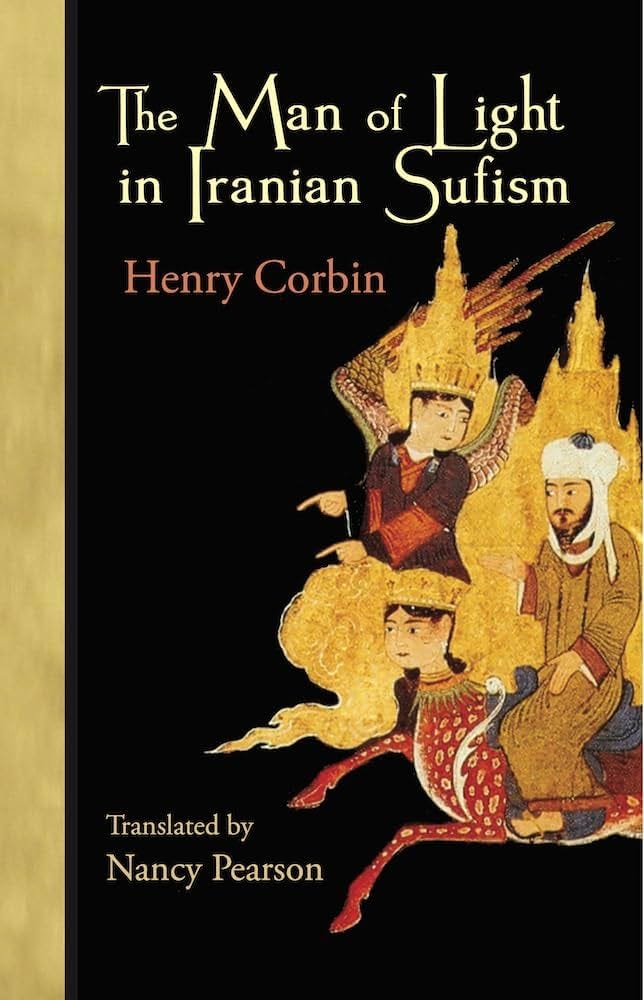
Henry Corbin’s The Man of Light in Iranian Sufism preserves this older atmosphere with extraordinary clarity. Again and again, Corbin describes a hidden aristocracy of souls—invisible initiates, “Friends of God,” beings who have ascended vertically beyond ordinary consciousness and who function as living poles of spiritual orientation.
And unexpectedly, this begins to converge with Nietzsche—not the Nietzsche of undergraduate atheism or crude will-to-power caricatures, but the Nietzsche obsessed with rank, altitude, overcoming, and the creation of higher forms of humanity after the collapse of inherited metaphysical structures.
The convergence becomes startling in Corbin’s discussion of the pole (qotb), the invisible spiritual axis around which the cosmos turns.
Corbin writes: “Just as the constellation of the Bear dominates and ‘sees’ the totality of the cosmos, they are themselves the eyes through which the Beyond looks at the world.” And elsewhere: “God cannot look at an other than himself, nor be seen by an other than himself. The Awliyā’, the ‘initiates,’ are precisely the eyes at which God looks, because they are the eyes through which He looks.”
This is one of those passages that appears purely mystical until one realizes its philosophical implications are explosive. The initiate does not merely worship God, he becomes the site through which divinity perceives reality. The awakened soul becomes an organ of divine cognition. At this point the distance between Iranian Sufism and Nietzsche begins to collapse in fascinating ways.
Nietzsche repeatedly suggests that humanity cannot remain merely human after the death of transcendence. The old God disappears, but the metaphysical need for height, orientation, creation, and spiritual rank does not disappear with Him. Something must replace the collapsed heavens. Hence Nietzsche’s terrifying formulations: “If there were gods, how could I endure not to be a god?” Or again: “Dead are all gods: now we want the overman to live.”
This is usually interpreted psychologically or existentially—but there is also an epistemological dimension. The higher human being does not merely possess different opinions, he sees differently, he becomes capable of bearing perspectives inaccessible to ordinary consciousness. That is exactly what Corbin’s initiates are.
They inhabit “heights inaccessible to earthly beings.” They are not democratic subjects among other subjects. They are vertical beings. The hidden architecture that prevents the world from collapsing into chaos.
Corbin even says explicitly that without the pole, the hidden Imam who serves as the metaphysical axis of the world, “our world would collapse in final catastrophe.” Nietzsche arrives at something strangely similar from the opposite direction. Once God is dead, modernity begins to flatten. Everything becomes horizontal: mass politics, utilitarian morality, collectivized identity, secular administration, herd psychology. The crisis is not simply theological but gravitational—civilization loses altitude.
This is why Nietzsche’s language becomes increasingly obsessed with mountains, peaks, distance, stars, Hyperboreans, noon, cold air, and ascent. The Overman is not merely morally superior—he is structurally vertical.
Corbin names the same conflict directly: “The vertical dimension is individuation and sacralization; the other is collectivization and secularization.” This sentence could almost summarize Nietzsche’s entire diagnosis of European nihilism.
Modernity expands horizontally—it universalizes everything. It destroys inward hierarchy and socializes the soul. Symbols cease to orient upward and instead become flattened into politics, psychology, sociology, identity.
The result is what both thinkers despise most: mediocrity masquerading as enlightenment. Against this flattening, both Corbin and Nietzsche invoke the North.
Nietzsche frequently calls himself a Hyperborean—one who inhabits a region beyond the exhausted moral climate of Europe. Corbin speaks of the “cosmic North,” a shadowless land inhabited by beings of light. Neither North is geographical, but are ontological.
North signifies orientation toward transcendence. Toward altitude, another atmosphere of being. And this is where the comparison becomes most provocative: both thinkers imply that spiritual ascent culminates in something dangerously close to divinization. For Corbin, the initiate becomes the very eyes through which God sees the world. For Nietzsche, humanity must overcome itself and become creator rather than creature.
In both cases, ordinary humanity is transitional, as something higher is attempting to emerge through man.
The difference, of course, is immense. Corbin remains within a sacred metaphysical cosmos. Nietzsche attempts to think beyond all inherited transcendence. Corbin’s initiate becomes transparent to divine reality; Nietzsche’s higher type creates values after the collapse of divine guarantees.
And yet both arrive at a similar intuition: man cannot remain merely horizontal.
The human being either ascends or degenerates—either becomes a bridge upward or dissolves into the collective. This is why both thinkers are fundamentally anti-modern, though not reactionary in the ordinary sense. They are not simply nostalgic for the past. They are revolting against flattening itself, against the reduction of the soul to sociality, against the replacement of initiation with information, and against a civilization that produces infinite connection while destroying vertical orientation.
Nietzsche’s image of the madman who announces the death of God carrying a lit lantern “in the bright morning hours” takes on a deeper significance here. Why carry a lamp at dawn? Because the light he bears is not the ordinary daylight of the marketplace. His lantern symbolizes the persistence of vertical seeing inside a civilization that has become purely horizontal. And the scene occurs at daybreak, not noon: a liminal moment in which the old gods are dead but no new orientation has yet emerged. In this sense, Nietzsche’s madman resembles one of Corbin’s initiates, bearing an inner light incomprehensible to the collective consciousness around him.
Perhaps this is also why dawn imagery matters figures so centrally to both: Corbin’s mysticism is filled with initiatory light, northern suns, celestial poles, hidden stars. Nietzsche’s book Daybreak announces itself as the first illumination after a long European night. In both cases, awakening is solitary and dangerous—not everyone survives higher air.
Modernity promises universal daylight—but Nietzsche and Corbin seek something more severe: a difficult illumination reserved for those capable of ascent. A cold dawn. A midnight sun.
The conclusion is that the highest human being is not merely one who believes in God, but one through whom God—or whatever succeeds God—begins to see.
Never thought I'd see Nietzsche and Islam in one post.