
Raphael's Arsenal
Raphael’s strange combination of enormity and intimacy

I saw the Met’s massive exhibition on Raphael, and what struck me most was the volume of all his work on display. I guess I didn’t realize how prolific he was—which is especially interesting given how short his life was (he died at 38). At the show you walk through endless displays of sketches that would be used in his masterpieces. I got a feeling of a certain aggressiveness—constantly building weapons to be used in constructing his masterpieces; a highly organized, precise, almost militarized stock of drawings. An arsenal.
The show is full of drawings, studies, fragments, preparatory faces, drifting saints, partial Madonnas, hands reaching toward nowhere. A nose. A tilt of the neck. A grieving mother. A certain softness around the eyes. A muscular shoulder rotated three degrees further toward heaven. Everything is prepared in advance, refined, sharpened, stored. And standing among them, you realize that Raphael did not work like a mystic waiting for inspiration. He worked like a conqueror assembling an arsenal—having all his tools ready to use when he received a commission, or when he received a strike of inspiration telling him how to put it all together and assemble it into a masterpiece. The drawings feel weapons testing. I’m reminded of one of my favorite Nietzsche quotes: that “only those opinions and ideas that you have at ready-command” really belong to you—you have to constantly refine your ideas and carry them near the surface, so that you can use them. Otherwise they don’t really exist—they’re more like inklings or feelings that haven’t been worked up into an effective material that can impact the world. And it also means that you have to be constantly looking for ways to use your ideas in the world, and this will motivate you to have your ideas at ready-command, close to the surface.
What’s unique is that this militarized preparation never results in coldness. Usually when an artist becomes this systematic, individuality begins to disappear. Scale produces generality. The larger the composition, the flatter the human beings inside it become.
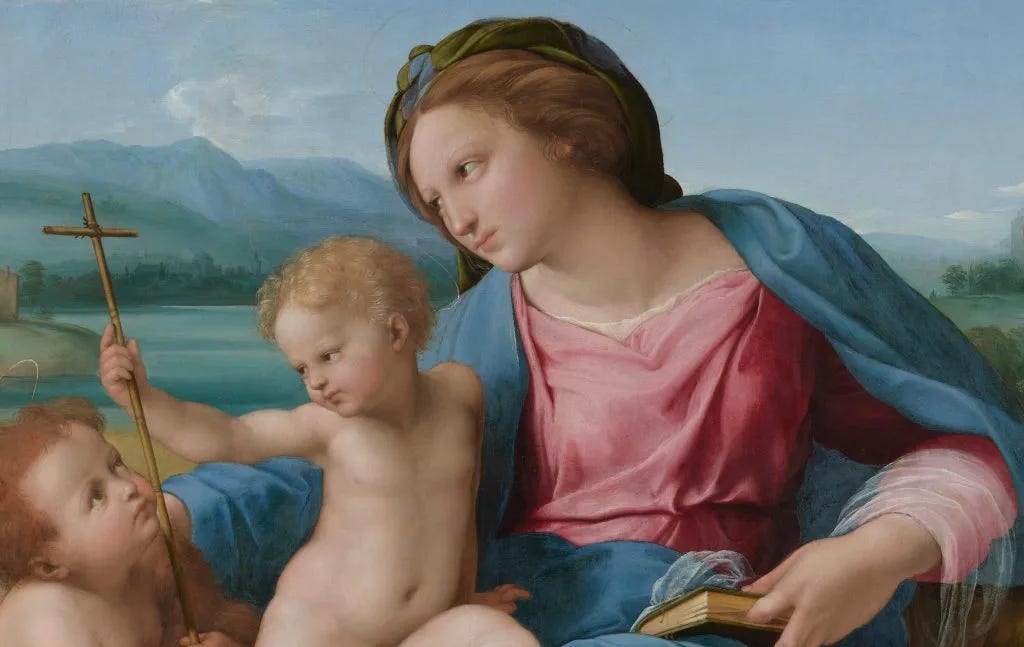
But Raphael seems to use systemization for the opposite purpose: to preserve subjectivity inside enormity. Part of his genius is that he seamlessly merges things that don’t usually go together: maximalism and specificity. Usually the maximal artist dissolves into generality. Once scale increases, individuality disappears. The giant fresco, the crowded canvas, the imperial project—these things tend to flatten people into symbols. But Raphael never loses the person—and that’s where his real genius lies, I think. Every face he paints retains its own interior weather. Every figure seems to possess a private psychological atmosphere. Even when he is orchestrating enormous scenes with impossible quantities of bodies, gestures, draperies, architectural rhythms, and theological meanings, each individual still feels singled out by consciousness itself.
That combination is incredibly rare. Most maximalism becomes anonymous. Raphael’s maximalism becomes intimate.
You can feel, moving through the exhibition, how obsessively he prepared for this effect. The studies are modular without feeling mechanical. He appears to have built a vast internal inventory of human possibilities—expressions, emotional temperatures, postures, glances—that could later be deployed into larger compositions. Not copied and pasted—activated.
There is something almost modern about it. Or cinematic. Like a director accumulating fragments long before the final assembly exists. He seems to understand that largeness cannot be improvised. Grandeur requires stockpiling. (Thinking about the connection between war and cinema that I’ve written about before…)
The trick is to make sure the stockpile never becomes dead material—that is the genius of Raphael: nothing feels generic even though everything is reusable and modular.
A lesser artist repeats himself because he has run out of vision—Raphael repeats because he has discovered forms deep enough to survive recombination. The same face can migrate between works and still feel alive under different spiritual conditions. The same gesture can carry a different metaphysical charge depending on where it appears.
His drafts reveal that great art is often less spontaneous than strategic. Not strategy in the cynical sense, but in the sense of preparing enough emotional and formal precision that the final work can sustain enormous scale without collapsing into abstraction. It’s interesting to note that Raphael’s strategic bent was so pronounced that Leonardo da Vinci advised him to become more spontaneous in his sketches, so he could capture the spirit of life more fully. (This is mentioned in the exhibition—I didn’t know that Raphael and Leonardo actually interacted).
Raphael was not simply painting masterpieces, but meticulously constructing a system capable of generating them continuously—an engine of specificity, an arsenal of faces, a maximalism so disciplined that it could preserve subjectivity even at monumental volume.
>A lesser artist repeats himself because he has run out of vision—Raphael repeats because he has discovered forms deep enough to survive recombination.
Forms don’t have depth, spiritual or otherwise.
Wow, great piece! I've been learning more about painting and visual art more, so this was perfect timing. Hopefully more to follow!